
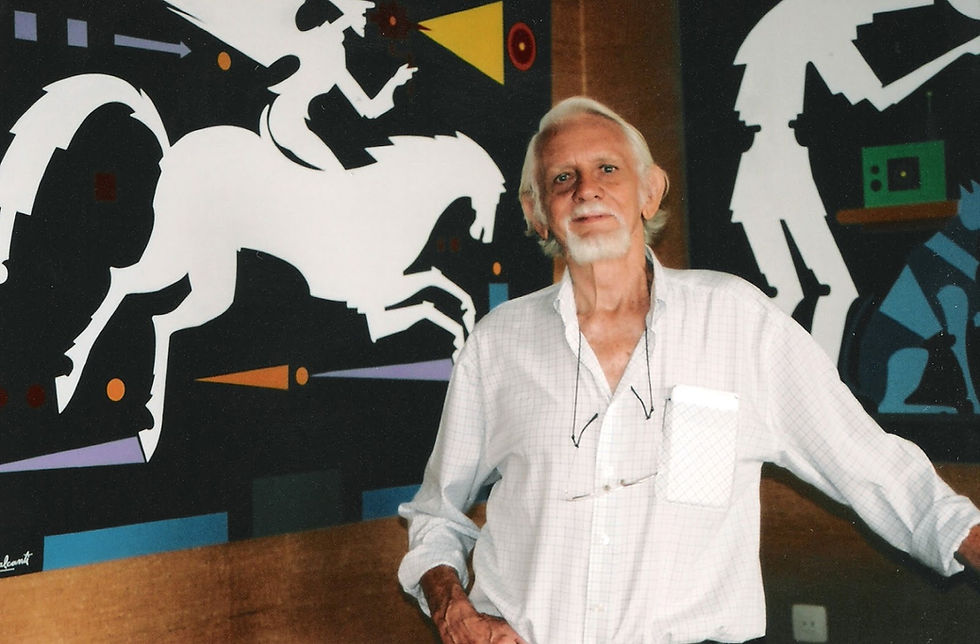
Otto Cavalcanti
Otto Cavalcanti (1930–2019) was a Brazilian-born artist whose work traversed continents and movements. After beginning his career as an illustrator in Rio de Janeiro, he moved through Madrid, London, Paris, and ultimately settled in Barcelona, where he became part of the Catalan avant-garde. His work blended figuration and abstraction, drawing inspiration from music, robotics, nature, and the human form. From his early surrealist influences to the development of his own “Combinism of Visual Forms,” Cavalcanti created a visual language rooted in rhythm, geometry, and vibrant emotion — always shaped by his dual identity as a cosmopolitan and a Northeastern Brazilian.

Creative Process
Otto Cavalcanti
Cavalcanti’s practice was deeply experimental — shifting between watercolor, sculpture, mural painting, and mixed media. His studios in Barcelona and Brazil were creative laboratories where tropical imagery met conceptual form. Each work carried echoes of travel, memory, and improvisation, often layering symbolism from Afro-Brazilian culture, childhood recollections, and European modernism. His compositions vibrate with color and movement, reflecting a mind that saw no boundaries between the personal and the political, the poetic and the technological.


